
Manga Translation Glossary: Stop AI From Changing Character Names
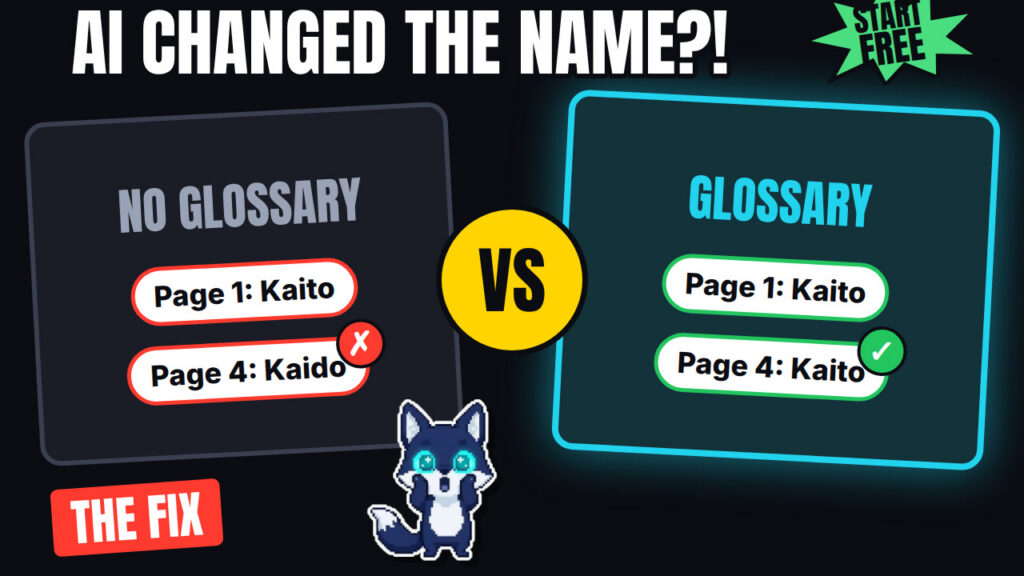
Your AI manga translator called a character one name on page 1 and a different name on page 4? That’s one of the most common problems with machine translation of manga, manhwa and manhua. This guide explains why names and terms drift, and how a glossary keeps them the same in every chapter.
Watch: the glossary fix in 50 seconds
A real example from our test
When we timed an AI manga translator on 11 real pages, one page had a menu item called “Midnight Tonkotsu Special”. Without a glossary, a few pages later the same item came out as “special ramen”. With a glossary, it stayed “Midnight Tonkotsu Special” on every page.
| Page 1 | Page 4 | |
|---|---|---|
| No glossary | Midnight Tonkotsu Special | special ramen |
| With glossary | Midnight Tonkotsu Special | Midnight Tonkotsu Special |
Why names and terms drift
An AI translator works through a chapter page by page. Each page is translated with the context it can see, so a name, a nickname or an invented word can come out slightly differently from one page to the next. Short names written in katakana or hangul, made-up attack names and food or place names are the usual suspects. Readers notice right away, and it breaks immersion.
How a glossary fixes it
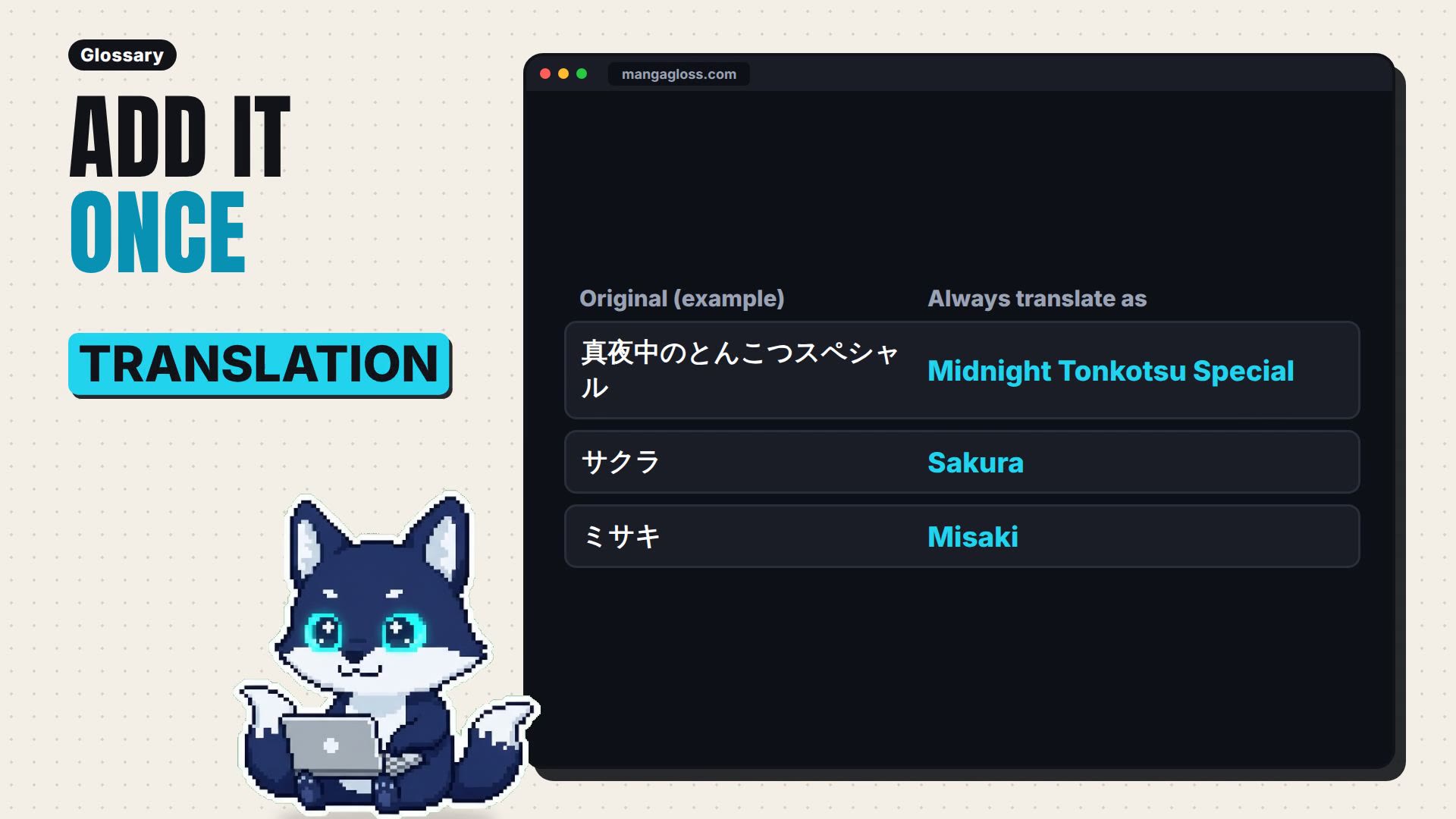
- Add the original term once. For example, a character’s name exactly as it appears on the raw page.
- Add the translation you want. The spelling you want readers to see every time.
- Translate as usual. Every page in the series uses your translation for that term.
What to put in your glossary
- Character names, including nicknames that should keep a specific spelling.
- Attack and skill names, especially invented words.
- Places: towns, schools, guilds and kingdoms.
- Items and menus, like the ramen in our test.
- Titles and ranks that you want to keep consistent.
Keep one glossary per series. A name that’s right for one series can be wrong for another.
Glossary tips
- Start with the main cast. Five or six names already fix most of the problems readers notice.
- Add terms as they appear. When a new name shows up in a chapter, add it before translating the next one.
- Pick one spelling and stick to it. For example, decide between “Kaito” and “Kaitou” once.
- Still read every page. A glossary fixes consistency, not every translation choice. The editor handles the rest.
Which plans include the glossary?
The glossary comes with the Creator and Pro plans. Creator is $9 a month for 1,500 pages, about 75 chapters. If you follow a series every week, that’s usually the plan we recommend. Compare the options in free vs paid manga translator, or start with the free manga translator.
Frequently asked questions
Why does AI translation change character names?
Because each page is translated with limited context, the same name or invented word can be rendered differently on different pages. A glossary tells the translator which version to use every time.
Does a glossary work for manhwa and manhua?
Yes. It works the same way for Japanese manga, Korean manhwa and Chinese manhua.
Can I have a different glossary for each series?
Yes. The glossary is per series, so names from one series don’t affect another.
Is the glossary free?
The glossary is part of the Creator and Pro plans. Free pages use the same AI, without the glossary and editor.
Keep names consistent from now on
See the plans on the pricing page, or try the AI manga translator free first.