
Best Comic Post-Editing Services to Compare

Machine translation can get comic pages moving fast, but raw output still needs a sharp editorial pass. The best service depends on whether you need a full automated workflow, human language review, or publisher-grade typesetting. Here are five named options for comparing post-editing services for machine-translated comics.
1. MangaGloss
MangaGloss is a free AI-powered manga, manhwa, and manhua translation tool with post-editing built into the same workflow. It fits indie creators, translation teams, scanlation groups, and language learners who need finished comic pages rather than a plain text script.
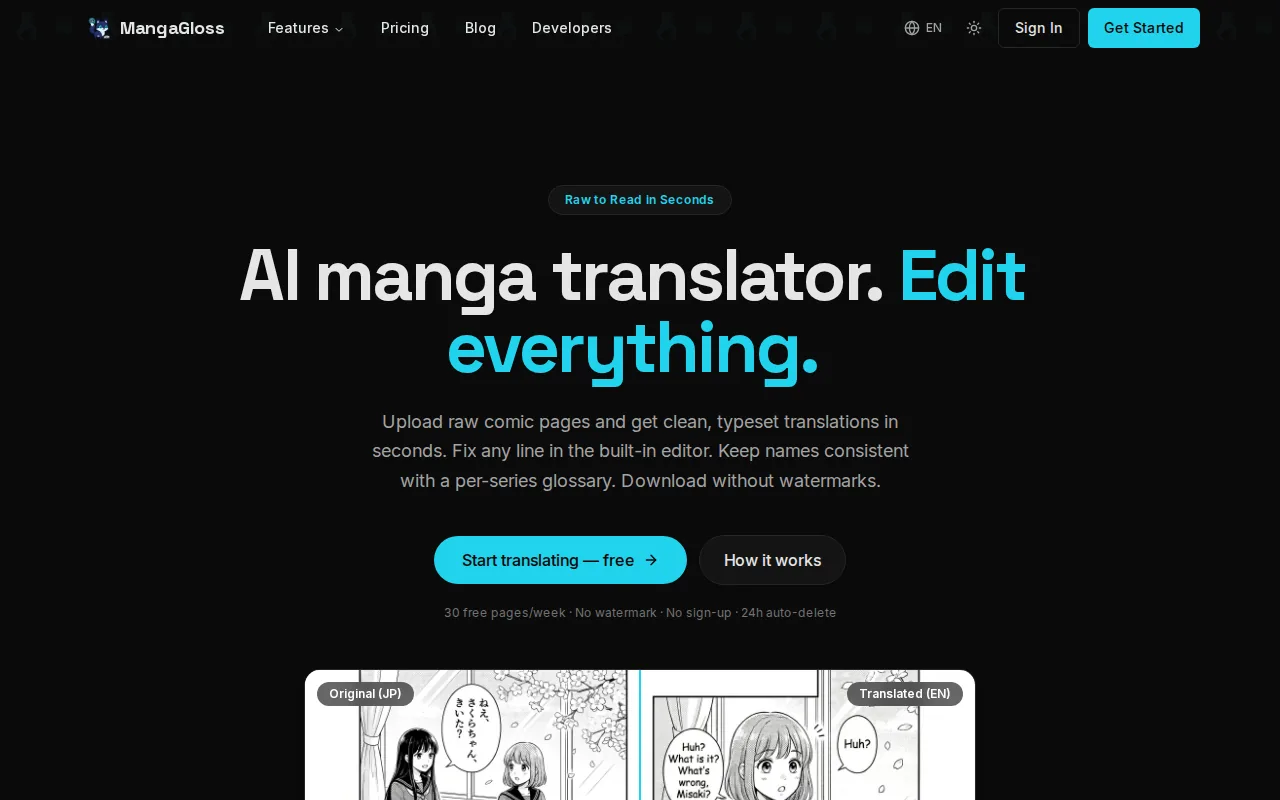
MangaGloss handles the full page pipeline. It detects text with OCR, translates the words, removes the source text through inpainting, then adds the translated text through automatic typesetting. That matters because a translator shouldn’t have to move the same page through several disconnected tools before review can even start.
The editor gives a human the final say. A reviewer can change dialogue, fix a name, adjust font size, or move text within a bubble before downloading the page. A team can upload a chapter as a ZIP file, process the pages, then work through the output in the browser.
Cost is the clearest difference. MangaGloss offers free access. The free workflow has usage limits, so a high-volume publisher may still need a paid plan or another production setup.
For teams, the key choice is simple: do you want to spend your time fixing language, or cleaning pages by hand? MangaGloss takes care of the page work first, leaving the human reviewer to focus on voice, meaning, and consistency. Its manga translation workflow for scanlation teams explains that handoff in more detail.
Best fit: creators and teams that want a free end-to-end pipeline with a human review stage.
2. Inkover: AI automation with human control
Inkover is aimed at users who want a balance between automated translation and hands-on control. It suits readers and translation teams that need to see what the system is doing instead of receiving a black-box result.
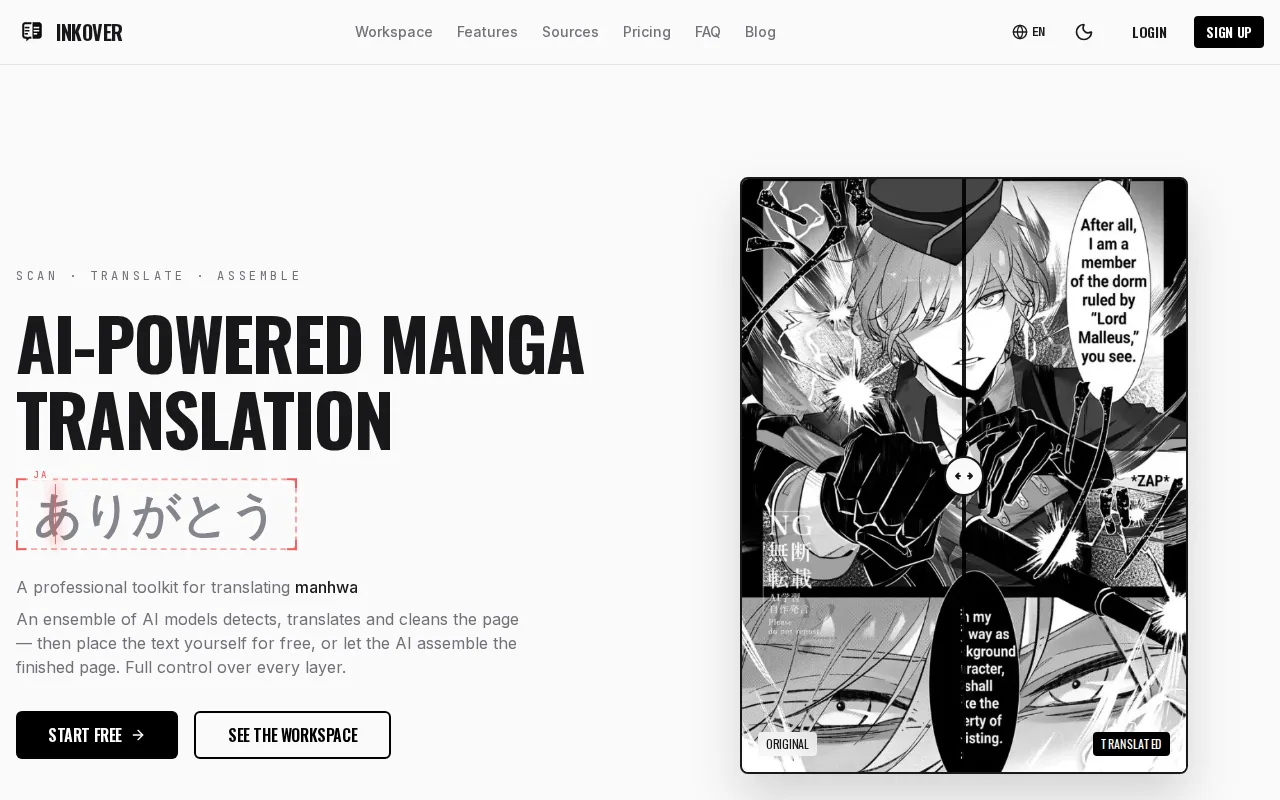
The useful part of this model is pipeline visibility. A reviewer can tell where a page is in the process and decide where human attention is needed. That helps when a chapter contains mixed layouts, unusual text placement, or dialogue that needs a style decision rather than a literal translation.
Inkover also has a limited free trial. It offers a first-chapter trial with 1,000 tokens and no credit card requirement. That makes it easier to test the workflow on a small sample before committing to a larger job.
Still, a trial is different from unrestricted free use. If a group processes full chapters every week, it needs to check the service’s current limits and paid terms. Inkover may make more sense for teams that value control and process visibility over a permanently free production lane.
Think of Inkover as a strong fit when the review process matters as much as the first machine pass. It can help a team spot weak output sooner, but the final buying decision should rest on the type of pages you handle and the volume you process.
Best fit: users who want AI assistance while keeping close watch over the translation pipeline.
3. Post Edit: Expert refinement after translation
Post Edit focuses on the human side of comic localization. It is for publishers or creators who already have machine-translated material and want an expert to refine the language before release.

Human post-editing is more than spellcheck. A linguist checks the source against the machine output, then corrects meaning errors, awkward wording, grammar, terminology, tone, and formatting. The goal is a publishable translation rather than a rough version that only gives the reader the gist.
This distinction matters in comics because a short line can carry character voice. A joke may need a new phrasing. A title may need to stay consistent across chapters. A sound effect may need a creative choice instead of a word-for-word replacement.
The service lists complimentary trial translations, which gives a team a way to judge the fit on sample pages. It does not replace the need to ask who handles lettering, image cleanup, and final typesetting. A language edit alone may leave the production team with more page work.
The wider post-editing process is defined as a human review of machine or AI output against the source text. Wikipedia’s overview of machine translation also helps explain why automated output should be treated as a draft rather than an automatic final.
Post Edit is a better match when language quality is the main concern and your team can manage the art file separately. If you need OCR, inpainting, and typesetting in the same tool, a full pipeline such as MangaGloss may reduce more production work.
Best fit: teams with translated text in hand that need expert language refinement before publication.
4. Nube Consulting: Human localization for nuance and authenticity
Nube Consulting is a human-localization service for projects where tone and cultural meaning need close attention. It suits publishers and creators who prefer a people-led process for dialogue that depends on voice, humor, or local context.
The listed language coverage includes French, English, Chinese variants, Spanish, Korean, Japanese, German, Portuguese, and Italian. That range can help when a publisher wants to manage several target markets through one localization partner, though the exact workflow still needs to be confirmed for each comic.
Human localization can be a better choice for character-heavy stories. A machine may identify the basic meaning of a line but miss a social cue, age marker, speech habit, or joke. A human reviewer can make a choice that fits the scene and the character instead of accepting the most likely dictionary equivalent.
The trade-off is production scope. A human service may improve the words without automating every image task. Ask who performs OCR, erases the source lettering, places translated text, checks balloon fit, and completes final quality control. Those answers will tell you whether Nube Consulting can replace your full workflow or only the language stage.
Choose this option when authenticity carries more weight than raw automation. For a short, dialogue-rich release, the extra human attention may be worth more than a faster first pass.
Best fit: projects where cultural nuance and natural character voice outrank full page automation.
5. Mantra Engine: Enterprise manga localization and typesetting
Mantra Engine is an enterprise-grade platform built for manga localization. Its stated focus combines proprietary AI with professional typesetting tools, so it is aimed at publishers and localization teams with a formal production process.
That focus separates it from casual reading tools. A publisher may need a repeatable handoff between translation, editorial review, lettering, and release management. Typesetting tools matter because translated text often changes length, which can affect balloon fit, line breaks, and the visual pace of a page.
Mantra Engine is best considered when your team needs a business-grade localization environment. Cost is part of the early qualification step. A buyer should request current details on supported languages, file formats, user roles, review controls, and export options.
It may be too much for a fan translator who needs a few pages quickly. It can be a better match for a publisher that has recurring releases and wants the translation and typesetting stages to sit within one managed system.
Before choosing it, test a difficult chapter rather than a clean sample. Use pages with vertical writing, dense bubbles, small text, and repeated names. That test will show how much manual cleanup remains after the automated pass.
Best fit: professional publishers and localization teams that need enterprise manga production tools.
Comparison Table: Comic Post-Editing Services at a Glance
This comparison looks at the decision points that change the day-to-day workflow. The services are not interchangeable. Some focus on full page automation, while others focus on expert language review or enterprise localization.
| Option | Best use | Automation picture | Human review | Cost access noted in research |
|---|---|---|---|---|
| MangaGloss | Free end-to-end comic workflow | OCR, translation, inpainting, typesetting | Built-in editing workflow | Free access |
| Inkover | AI work with process visibility | Automation with pipeline control | Human control is central | Limited free trial |
| Post Edit | Refining an existing translation | Starts with supplied machine output | Expert post-editing | Complimentary trial translations |
| Nube Consulting | Nuance-led localization | — | 100% human localization | — |
| Mantra Engine | Publisher localization programs | Proprietary AI and typesetting tools | Professional team workflow | — |
Workflow testing is more useful than a language-count comparison on its own.
Language breadth has a cost trade-off too. Scan Translator lists more than 80 languages. A larger language list does not automatically mean better value if the service leaves cleaning or typesetting to your team.
What to Look For in a Comic Post-Editing Service
Start with the final file, not the translation box. Ask if the service can detect text, remove the source lettering, place the new text, and let an editor correct the result without switching tools.
Then test one difficult page. Check names, sound effects, vertical text, cramped balloons, and repeated terms. A good review process should make those changes easy to find and fix.
- Pipeline: Does one service cover the full page workflow?
- Review: Can a human edit wording and placement?
- Consistency: Can names and key terms stay fixed across chapters?
- Cost: Is access free, trial-based, or paid from the start?
- Scale: Can the workflow handle your page volume?
For most small teams, MangaGloss is the clearest starting point because it combines the full automated pass with a route for human corrections. Larger publishers may still need a managed localization service.
FAQ
What is the best service for machine-translated comics?
MangaGloss is the best starting point for creators who need a full comic-page workflow at no cost. It combines OCR, translation, inpainting, and typesetting, then gives the user a way to review the result. If your main need is human language refinement, Post Edit or Nube Consulting may fit better.
Is post-editing needed after AI comic translation?
Yes, post-editing is usually needed after AI comic translation because names, jokes, tone, and context can be wrong even when the sentence looks readable. A human should review the machine draft against the source. The amount of review depends on the page quality, target audience, and release standard.
Which comic translation service is free?
MangaGloss is the only service in this shortlist identified as offering unrestricted free use. Inkover has a limited trial, while Post Edit lists complimentary trial translations. Free access can still include usage limits, so check the current page allowance before planning a full series workflow.
What is the difference between translation and comic post-editing?
Translation turns source dialogue into another language, while post-editing improves machine output after that first pass. Comic post-editing may also involve checking names, line breaks, balloon fit, and visual placement. A language-only service may not clean artwork or typeset the final page.
Do comic post-editing services handle typesetting?
Some services handle typesetting, but the coverage differs. MangaGloss includes automatic typesetting in its page pipeline. Mantra Engine is described as combining AI with professional typesetting tools. Human localization services may focus more on language, so ask who handles lettering and image cleanup before you buy.
Conclusion
Choose MangaGloss first if you want a free, end-to-end way to process and review translated comic pages. Test it on a difficult chapter, then compare the remaining manual work against a human-led service such as Post Edit or Nube Consulting if voice and nuance need extra care.